Flanged Ball Valve Supply & Manufacture
Material
- ValveBody:Ductile Iron QT450
- Valve Cover:Ductile IronQT450
- ValveBall:SS304
- Valve Seats And Gaskets:PTFE/EPDM
- Valve Stem:SS304
- Valve Stem Packing: PTFE/EPDM
- Lever:Ductile IronQT450/SS304
- Paint:Epoxy
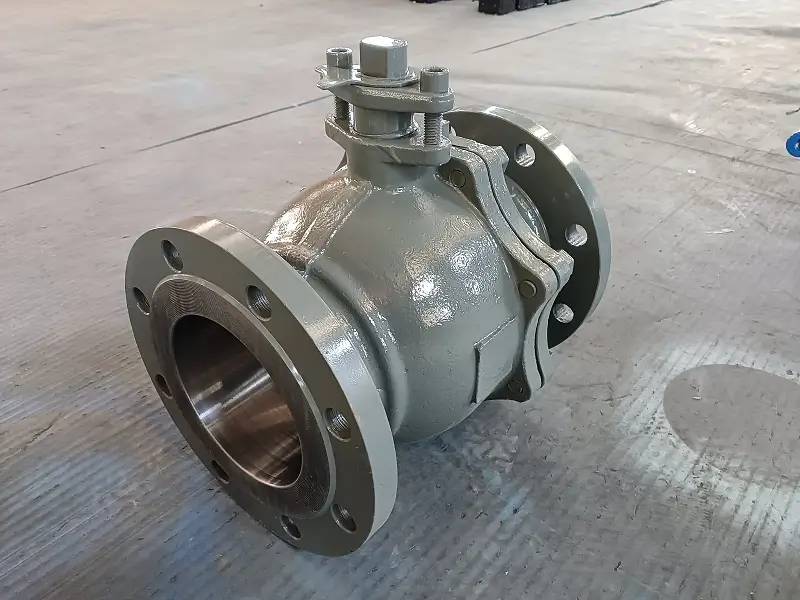
Feature of flanged ball valve
- Bidirectional sealing: The valve seat is made of elastic material (such as PTFE), which can achieve bidirectional tight sealing in combination with the medium pressure. It is temperature resistant from -196℃ to 540℃ and is suitable for corrosive media.。
- Quick opening and closing: 90° rotation for full opening/closing, supports manual, pneumatic or electric drive, and the handle has a locking mechanism to prevent misoperation.
- Multiple safety protections: fireproof design (emergency metal seal), anti-static structure and stem anti-flying design to ensure safety in extreme working conditions。
- Low flow resistance and wide application: The full-diameter flow channel has low resistance and is suitable for water, gas, oil and corrosive media, covering industries such as petrochemicals and electric power, and conforming to domestic and international standards.
Specification of flanged ball valve
Size | DN 25 to 350 |
Valve Body | Ductile Iron QT450 |
Valve Cover | Ductile Iron QT450 |
Valve Ball | SS304 |
Valve Seats And Gaskets | PTFE/EPDM |
Valve Stem | SS304 |
Valve Stem Packing | PTFE/EPDM |
Lever | Ductile Iron QT450/SS304 |
Paint | Epoxy |
Body Style | 1/2/3Piece |
Design Standard | API 608, ASME B16.34, MSS SP72, NACE MR0175 |
What is flange ball valve?
The flange ball valve is a valve with flange connection and ball opening and closing. It can be quickly cut off by rotating 90°. It has bidirectional sealing and low flow resistance characteristics. It is suitable for the control of liquids, gases and corrosive media in the petroleum, chemical and other industries.
How does the flange ball valve work?
The flange ball valve rotates the ball 90° through the drive device, and uses the medium pressure to make the valve seat and the ball fit tightly to achieve bidirectional sealing. The full-bore structure reduces flow resistance and is suitable for high-pressure and corrosive medium control.
Types of Flange Ball Valve
Flange ball valves are mainly divided into floating type (valve seat pressure seal), fixed type (shaft fixed high pressure resistance), full bore (small flow resistance), reduced bore (economical type) and three-way/V type (multi-directional flow regulation) types.
Installation & Maintenance
When installing a flange ball valve, the flanges must be aligned, the bolts must be pre-tightened symmetrically, and the medium flow direction must be consistent with the valve body marking. During maintenance, the sealing surface must be lubricated regularly, and the valve seat wear and valve stem obstruction must be checked. Forced opening and closing is prohibited.
Application of Flange Ball Valve
Flanged ball valves are used in pipeline systems in the petrochemical, electric power, environmental protection and other industries to control water, gas, oil and corrosive media, adapt to high pressure, high and low temperature working conditions, and meet the needs of two-way sealing and rapid cutting.
Why Choose Lanhui Valves for Your Flanged Ball Valves?
Our flanged ball valves are made of special alloys and PTFE valve seats, which are corrosion-resistant (-196℃~540℃) and high-pressure (PN32). The floating/fixed double seal structure ensures zero leakage. They are equipped with fireproof, anti-static and anti-stem flying design, meet API/ISO standards, support customized services and rapid response after-sales, and are suitable for harsh working conditions such as petrochemical, energy, LNG, etc. The service life exceeds 100,000 times, and the maintenance cost is reduced by 40%.